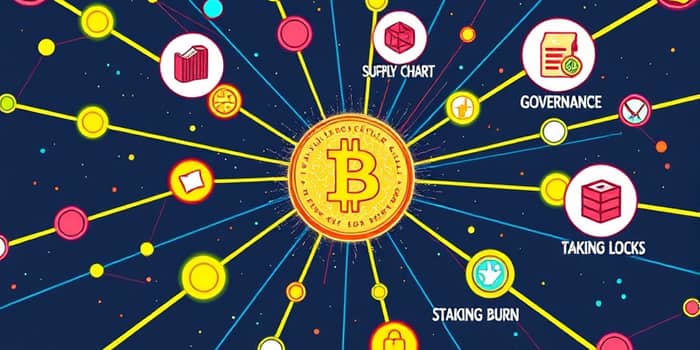
The study of tokenomics delves into the heart of how digital assets acquire, retain, and distribute value within decentralized ecosystems. As blockchain technology matures, understanding the underlying economic frameworks becomes vital for developers, investors, and users alike.
By examining supply dynamics, distribution methods, incentive mechanisms, and real-world use cases, tokenomics offers a comprehensive lens through which to evaluate project viability and long-term sustainability.
Core Components of Tokenomics
At its foundation, tokenomics blends elements of monetary policy, game theory, and system design. It examines how tokens generate and retain value by defining issuance rules, participant incentives, and network dynamics.
Key components include token supply metrics, distribution frameworks, utility functions, and incentive mechanisms that guide participant behavior and network security.
Supply Metrics and Distribution Models
Token supply is one of the strongest drivers of perceived value. Economists and blockchain architects analyze three primary metrics to gauge scarcity and market availability:
Beyond raw numbers, distribution models shape network health and market sentiment. Common approaches include fair launches, pre-mining allocations, and community airdrops. Each method carries trade-offs between initial decentralization, fundraising efficiency, and long-term sell-pressure.
Lock-up and vesting schedules add another layer: vested tokens represent sell pressure when released, often marking volatile price movements around unlock dates.
Incentive Mechanisms and Token Utility
Incentive structures align stakeholder actions with protocol objectives. Well-designed mechanisms ensure network security, encourage long-term holding, and stimulate active participation.
Tokens also serve diverse utility roles across decentralized platforms:
- Cryptocurrencies for value transfer and store of value (e.g., BTC)
- Governance tokens enabling voting and protocol upgrades (e.g., AAVE, UNI)
- Utility tokens granting access to services or network functions (e.g., LINK, ETH)
- Stablecoins offering price stability through collateral or algorithmic controls (e.g., USDT, DAI)
- NFTs representing unique digital or physical assets (e.g., BAYC, CryptoPunks)
Security through consensus often relies on staking or mining. Proof-of-Stake networks reward token holders for securing the network, while Proof-of-Work chains compensate miners for computational contributions. Token burning and liquidity incentives further modulate circulating supply and market liquidity.
Case Studies: Bitcoin, Ethereum, and Beyond
Bitcoin pioneered deflationary monetary policy on a blockchain. Its transparent and predictable issuance model, capped at 21 million coins and halved issuance every four years, has cemented its status as digital gold.
Ethereum evolved a more flexible tokenomics model, introducing fee burns through EIP-1559 to offset new issuance. This dynamic approach ties supply adjustments to actual network usage, fostering an elastic yet deflationary pressure when demand surges.
Emerging protocols like Hedera Hashgraph adopt hybrid models, combining council governance, fixed supply, and energy-efficient consensus to deliver enterprise-grade scalability. Meanwhile, tokenized real-world assets unlock liquidity for real estate, art, and revenue streams, showcasing tokenomics’ capacity to transform traditional finance.
Applying Tokenomics as a Strategic Framework
For stakeholders across the ecosystem, tokenomics serves distinct yet interrelated purposes:
- Developers craft economic models that drive user engagement and network security.
- Investors evaluate token metrics to assess growth potential and risk factors.
- Community members rely on token design to ensure transparent decision-making and sustainable incentives.
Sound tokenomics can propel a project to widespread adoption, while flawed economic design often leads to declining confidence and market value. In due diligence, focus on:
- Supply dynamics and emission schedules
- Distribution mechanisms and vesting timelines
- Utility functions and governance structures
- Real-world use cases and regulatory context
Ultimately, tokenomics is more than technical specification—it is a narrative of incentives, scarcity, and trust. By aligning economic design with community values and network objectives, tokenomics charts a path toward resilient, decentralized ecosystems of the future.
References
- https://www.ledger.com/academy/glossary/tokenomics
- https://www.exp.science/education/tokenomics-economic-blueprint-behind-digital-assets
- https://info.arkm.com/research/tokenomics-a-beginners-guide
- https://trustwallet.com/blog/announcements/what-is-tokenomics
- https://www.avax.network/about/blog/tokenomics-101-the-blockchain-big-picture
- https://pulley.com/guides/what-is-crypto-tokenomics
- https://www.coinbase.com/learn/wallet/tokenomics-101
- https://alpaca.markets/content/tokenomics-guide
- https://www.youtube.com/watch?v=FxWRafXqMhE