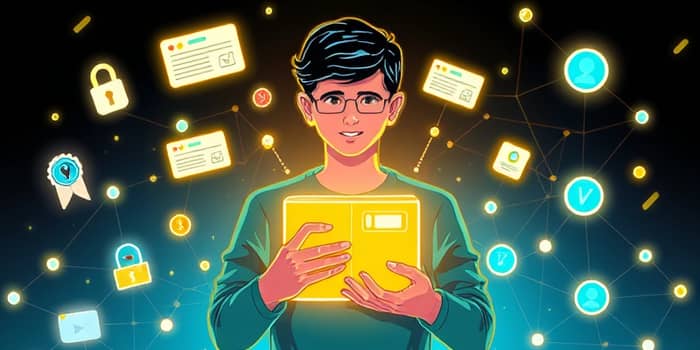
In an era where our personal data powers everyday transactions and defines online experiences, traditional identity systems are buckling under frequent breaches and data misuse. Self-Sovereign Identity (SSI) emerges as a beacon of empowerment, giving individuals full ownership and control over their digital identities. This model promises a world where you decide which pieces of your identity to share, when to share them, and with whom.
What is Self-Sovereign Identity?
Self-Sovereign Identity is a decentralized approach to digital identity management. Unlike legacy systems that store your data in centralized silos run by tech giants or governments, SSI places your personal credentials in a secure digital wallet on your device. You become the sovereign holder of your information, empowered to present only the facts needed for any interaction.
Imagine proving you are over 21 without revealing your full birth date or name. With SSI’s selective disclosure of data, you share only that single piece of information. This reduces your exposure to identity theft and tracking by intermediaries, creating a more private, secure digital environment.
How It Works: Trust Triangle and Core Protocols
At the heart of SSI lies the Trust Triangle: Holder, Issuer, and Verifier. Each actor plays a critical role in establishing a cryptographically secure identity ecosystem.
- Holder: You or your organization, storing digital credentials in a personal wallet on your device.
- Issuer: A trusted authority—such as a government agency or university—that issues digitally signed credentials (for example, passports or diplomas).
- Verifier: Any service provider or institution that cryptographically verifies your credentials without retaining personal data.
This peer-to-peer model eliminates the need for intermediate data repositories, vastly reducing the risk of large-scale breaches and creating direct trust channels between participants.
Technical Pillars of SSI
Self-Sovereign Identity stands on four foundational technologies, each ensuring security, privacy, and decentralization.
The SSI flow is straightforward: an Issuer signs a credential, the Holder securely stores it, and the Holder presents selective proofs to a Verifier over a DID-secured channel. This tamper-resistant storage on blockchains underpins trust without centralized intermediaries.
Key Benefits of Self-Sovereign Identity
- Enhanced Privacy: Share only what’s necessary, preventing mass data collection and surveillance.
- Robust Security: Cryptographic protections and no single point of failure reduce fraud and hacking risks.
- Global Portability: Your credentials work across borders and platforms without repeated registrations.
- User Empowerment: Full authority to revoke or control access to your personal data at any time.
By decentralizing identity, SSI fosters a new era of trust where individuals, organizations, and even IoT devices can interact with confidence.
Applications in the Real World
From digital passports and diplomas to health records and event tickets, SSI reshapes how we share information. Picture checking into a hotel without revealing your home address or purchasing age-restricted products by proving you are over 18 without exposing your birth date.
- Digital Government IDs: Instant verification at borders, reducing wait times and paperwork.
- Healthcare Credentials: Securely share vaccination records or prescriptions, safeguarding patient privacy.
- Financial Services: Access banking and lending in underserved regions without traditional KYC hurdles.
These scenarios illustrate the power of a user-centric and privacy-first model that can revolutionize industries and foster global inclusion.
Challenges and the Road Ahead
While promising, SSI faces hurdles such as interoperability between wallet providers, user experience barriers, and the need for regulatory frameworks. Effective key management remains critical—losing access to your wallet could mean losing your credentials.
By 2025, experts predict SSI will underpin many online and offline interactions, enabling secure and tamper-proof credentials for billions. As standards mature and ecosystem participants grow, we can expect seamless identity experiences that prioritize privacy without sacrificing convenience.
Conclusion: Embracing Digital Sovereignty
The evolution to Self-Sovereign Identity marks a transformative leap toward personal empowerment. To begin your journey:
1. Explore reputable digital wallets and follow best practices for secure key storage.
2. Seek verifiable credential issuers aligned with W3C standards.
3. Engage with open-source communities and advocacy groups shaping SSI governance.
By taking these steps, you can join a movement where every individual controls their digital footprint. Embrace SSI today and step into a future where identity is not given by corporations or states, but owned and managed by you.
References
- https://www.admonsters.com/what-is-self-sovereign-identity/
- https://www.miniorange.com/blog/self-sovereign-identity/
- https://pmc.ncbi.nlm.nih.gov/articles/PMC9371034/
- https://www.adnovum.com/blog/self-sovereign-identity-ssi-switzerland
- https://walt.id/white-paper/self-sovereign-identity-ssi
- https://seon.io/resources/dictionary/self-sovereign-identity/
- https://www.weforum.org/stories/2021/08/self-sovereign-identity-future-personal-data-ownership/
- https://www.authgear.com/post/decentralized-identity-explained-self-sovereign-authentication-guide
- https://www.okta.com/identity-101/self-sovereign-identity/
- https://en.wikipedia.org/wiki/Self-sovereign_identity
- https://cpl.thalesgroup.com/blog/access-management/self-sovereign-identities-control-personal-data
- https://www.dock.io/post/self-sovereign-identity