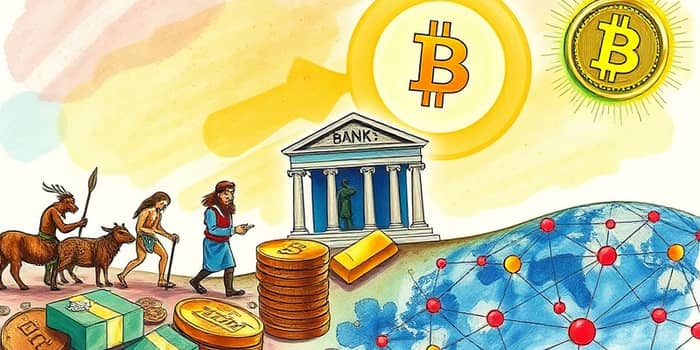
Money is more than coins and notes—it is the story of human ingenuity, trust, and adaptation. From prehistoric exchanges to sophisticated cryptocurrencies, the journey of money reveals lessons for our financial future.
Prehistoric Exchanges and the Rise of Commodity Money
Long before minted coins, communities relied on barter: the direct swap of goods and services. While effective in small groups, barter suffered from the double coincidence of wants. To overcome these limits, people turned to items with intrinsic value—cattle, shells, grains—as early commodity money.
Archaeological evidence from 9000–6000 BC shows domesticated livestock used as units of account. Over time, cowrie shells and metal tools became widely accepted, paving the way for more uniform mediums of exchange.
Mesopotamian Credit and Early Accounting
By 3000 BC, Mesopotamian temples recorded grain deposits on clay tablets. This innovation marked a shift: receipts for stored barley acted as transferable claims. Ancient scribes perfected ancient Mesopotamian credit systems, allowing merchants to settle debts without physical commodities.
Legal codes such as Hammurabi’s (c. 1930 BC) formalized debt, interest rates, and fines. The unit of account—the shekel—emerged as a specific weight of barley, foreshadowing representative money.
From Bronze Imitations to True Coins
Between 1200 and 1000 BC, China cast bronze cowrie replicas, easing the burden of transporting fragile shells. By 700–600 BC in Lydia (modern Turkey), rulers minted electrum coins stamped with lion symbols. This breakthrough introduced the standardized metal weight and coinage essential for trade across emerging empires.
Greece, Persia, and Rome quickly adopted coinage. Figures like Pheidon of Argos set weight standards, while Athenian silver drachmas fueled Mediterranean commerce. Challenges such as debasement—reducing precious metal content—prompted ever-stricter quality controls.
Medieval Innovations and Paper Precursors
After Rome’s fall, tally sticks in England and bill-of-exchange systems among Italian merchants represented early non-coin forms of value. Charlemagne’s silver penny (circa 800 AD) standardized Western Europe’s currency for centuries.
In 9th-century China, merchant promissory notes circulated alongside coins. By the Song Dynasty (960–1279 AD), the government issued official jiaozi notes due to copper shortages. These notes, backed by tax receipts, foreshadowed modern banknotes.
The Age of Paper Money and the Gold Standard
Europe embraced paper notes in the 17th century. Sweden issued the first European banknotes in 1661, followed by the Bank of England in 1694. Issuers promised to redeem notes for gold or silver on demand, embodying state-backed national currency issuance.
By the 19th century, the gold standard linked currencies to fixed gold weights, taming inflation and fostering global trade. Yet crises—such as the Bank of England collapse in the 1730s—reminded governments to maintain reserves and public confidence.
Modern Fiat Currency and the Digital Revolution
The 20th century saw most nations abandon commodity backing. Fiat money—valuable by government decree—enabled flexible monetary policy but introduced new risks. During Ming China’s hyperinflation (15th century) and modern crises, unchecked printing eroded trust.
Innovation continued: the first credit card appeared in the 1940s, electronic funds transfers emerged in the 1860s, and plastic cards became ubiquitous by the 1980s. Then in 2009, Bitcoin burst onto the scene as a peer-to-peer electronic digital currency system, challenging centralization and offering transparency through blockchain technology.
Lessons from Money’s Journey for Today’s Users
Understanding money’s evolution empowers us to navigate modern finance. Each transformation—barter to blockchain—reflects the quest for trust, convenience, and stability. We can draw practical insights:
- Maintain diversified savings to hedge against inflation and volatility.
- Embrace new payment technologies, while verifying security and privacy measures.
- Study monetary policy basics to make informed decisions about spending and investment.
- Recognize that trust underpins all monetary systems—be vigilant against fraud and debasement.
From cattle to cryptocurrencies, money has always been a social contract. By learning from its history, we can better adapt to future shifts—whether in digital wallets, central bank digital currencies, or innovations yet unseen.
Conclusion: The Ongoing Story of Money
The evolution of money is a testament to human creativity. Each innovation, from Mesopotamian grain credits to Bitcoin’s blockchain, emerged to solve the challenges of its era. As we stand at the threshold of new financial frontiers, embracing the lessons of the past can guide us toward a more inclusive and resilient economic future.
Money’s journey reminds us that progress stems from trust, technology, and collective belief in a shared medium of exchange. Our role today is to remain informed, adaptable, and vigilant—ensuring that the next chapter of money’s story serves humanity as brilliantly as the chapters that came before.
References
- https://www.jpmorgan.com/payments/payments-unbound/volume-2/how-paper-money-evolved
- https://www.providentmetals.com/knowledge-center/precious-metals-resources/history-of-money.html
- https://en.wikipedia.org/wiki/History_of_money
- https://www.mapscu.com/blogs/the-history-of-money/
- https://www.bankofengland.co.uk/explainers/how-has-money-changed-over-time
- https://www.uscurrency.gov/history
- https://www.youtube.com/watch?v=czEPG75wzPI