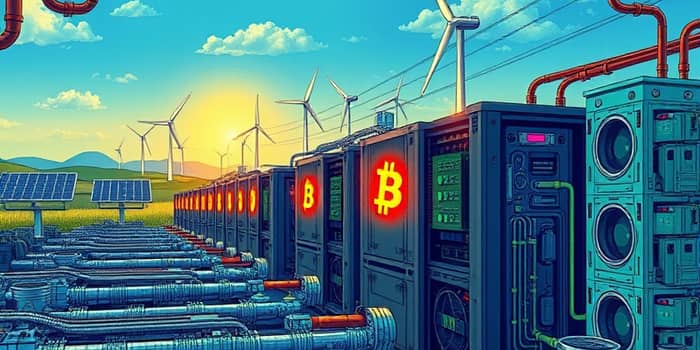
Cryptocurrency mining has evolved into a sophisticated industry driven by powerful hardware farms and proof-of-work consensus mechanisms. Miners contribute computational power to secure and validate transactions, earning rewards in the form of digital coins. As Bitcoin’s network expands and difficulty rises, the central question remains: can individuals and companies still generate sustainable profits from mining in 2026?
Today’s miners face a complex landscape shaped by fluctuating coin prices, escalating energy demands, and rapid hardware innovation. Understanding the interplay between these factors is essential for anyone considering an entry into this competitive field.
The Current State of Bitcoin Mining in 2026
Bitcoin miners collectively generate approximately $20 million worth of BTC every day, translating to roughly $600 million per month. This robust revenue stream reflects a market buoyed by Bitcoin’s price hovering near $95,000, following a peak above $126,000 in 2025.
Despite these impressive figures, margins are under pressure. Daily machine profits range from over $13 on top-tier rigs to mere cents on older equipment. With the network difficulty continually adjusting higher, staying profitable demands strategic planning, operational efficiency, and careful monitoring of market trends.
Key Profitability Factors: Electricity, Hardware, and Scale
Successful mining ventures hinge on three critical pillars. Any weakness in one area can erode profits rapidly, making a holistic approach vital for long-term viability.
- access to cheaper electricity – Rates below $0.07/kWh are essential for consistent returns.
- rigorous selection of efficient hardware – Modern ASICs deliver superior hash rates per watt.
- professional versus amateur mining dynamics – Large-scale farms access volume discounts and financial instruments.
Deep Dive into Hardware Efficiency and ROI
Hardware drives the mining engine. The newest ASIC models deliver hashrates above 500 TH/s at efficiencies near 15 J/TH. Cooling innovations, especially hydro systems, allow machines to operate continuously in warm environments.
Choosing the right rig impacts return on investment profoundly. Below is a snapshot of leading machines, illustrating daily net profits and expected payback periods:
Initial investment ranges from $2,000 to $20,000 per unit. Factory-fresh ASICs cost the equivalent of a dozen high-end graphics cards, underscoring the capital intensity of the business.
Understanding Electricity Costs and Alternative Energy
Energy expenses typically form over 70% of operational costs. Industrial miners often secure rates at or below $0.07/kWh, while residential tariffs in the U.S. average $0.12/kWh, pushing many home setups into loss territory from day one.
Innovators are exploring renewable and alternative energy sources—from solar arrays to flare gas capture—to slash power bills. Securing stable, low-cost electricity is non-negotiable for sustainable profits.
Mining at Scale vs. Individual Efforts
Large farms enjoy multiple layers of advantage: volume pricing on hardware, utility partnerships, and access to sophisticated financial hedging instruments. These institutional investment and hedging tools help mitigate volatility and optimize cash flows.
In contrast, individual miners face high setup costs, limited bargaining power, and unpredictable energy pricing. Pooling resources and joining reputable mining pools can bridge some gaps but rarely matches the scale efficiencies of industrial operations.
Exploring Diverse Mining Methods
Beyond Bitcoin’s SHA-256 algorithm, other mining avenues exist—but profitability varies widely. Understanding each method’s economics guides wise allocation of capital and resources.
- Bitcoin Mining (SHA-256): Profitable under optimal conditions with ASIC hardware.
- GPU Mining (Ethereum &altcoins): Marginal returns for most individuals in 2026.
- CPU Mining: Obsolete for major coins; only viable in crypto’s earliest days.
- DePIN (Decentralized Infrastructure): Offers diminishing returns in ASIC innovation and superior yields in certain networks.
Financial Projections and Investment Horizons
With electricity at $0.07/kWh and 500 TH/s of power, a miner can anticipate roughly $345 in monthly net profit, or about $4,200 annually. Mid-tier machines like the Antminer S21 XP deliver around $415 per month, with long-term investment and recovery timelines spanning 1.3 to 2.4 years.
Seasonal price fluctuations and network difficulty adjustments underscore the importance of maintaining healthy cash reserves and contingency plans for downturns.
Challenges, Outlook, and the Path Forward
Margin compression, rising competition, and hardware innovation plateaus pose ongoing challenges. Yet, regulatory clarity and global interest continue to attract capital, fueling gradual growth.
Potential catalysts for small-scale revival include wider access to renewable and alternative energy sources and collaborative mining models that distribute risk and reward across communities.
Conclusion: Who Should Mine—and Who Shouldn’t
Mining remains a specialized, capital-intensive undertaking. Aspiring participants must conduct a rigorous cost-benefit analysis framework, weigh electricity pricing, hardware costs, and operational expertise before committing funds.
For large operators with secure power contracts and balance-sheet resilience, mining continues to offer attractive returns. For hobbyists and small investors, exploring DePIN opportunities or smaller altcoin networks may present better entry points than direct Bitcoin mining.
Ultimately, the decision hinges on one’s risk tolerance, technical proficiency, and access to resources. By staying informed and adaptable, miners can navigate the evolving cryptocurrency ecosystem and strive for lasting profitability.
References
- https://bitbo.io/tools/mining-profitable/
- https://www.cryptominerbros.com/blog/most-profitable-bitcoin-mining-machines/
- https://www.asicminervalue.com/en/
- https://www.investing.com/analysis/is-2026-the-year-to-load-up-on-crypto-miners-200672929
- https://www.nicehash.com/blog/post/how-bitcoin-miners-can-stay-profitable-in-2026
- https://www.youtube.com/watch?v=eVoLcJmu4Ak
- https://www.youtube.com/watch?v=WT7_4VLnr50
- https://coincub.com/mining/bitcoin-mining-2026/
- https://www.youtube.com/watch?v=bBWzB5rl_6I