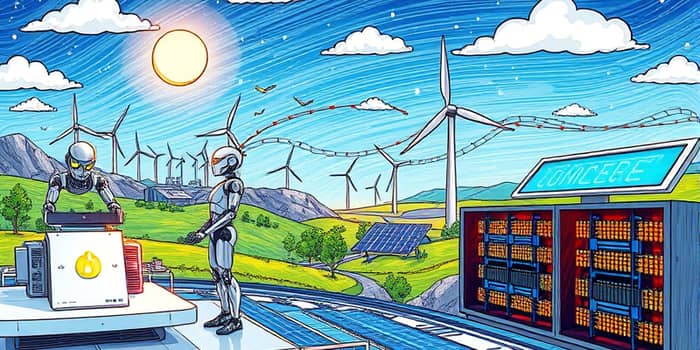
As 2026 dawns, investors find themselves at a pivotal crossroads. What separates fleeting hype from enduring opportunity? The answer lies in the practical application of breakthrough technologies and the ability to scale solutions that address real-world challenges. In this article, we explore the core themes shaping 2026 and outline actionable strategies for those ready to seize the moment.
The Rise of Applied AI and Technology Diffusion
Artificial intelligence has moved beyond academic proofs and into the heart of business operations. In 2025, global investment exceeding $300B underscored AI’s dominance as the top driver of innovation. No longer confined to theoretical models, AI now powers enterprise copilots, enables precision medical diagnostics, and optimizes complex industrial workflows.
Companies are racing to embed intelligence across every sector. Consider the following areas where AI diffusion is most pronounced:
- Enterprise copilots streamlining knowledge work
- Medical diagnostics leveraging multimodal models
- Industrial optimization with predictive maintenance
- Personalized education platforms tailored to learners
- Physical AI in robotics transforming logistics
- AI-driven drug discovery accelerating pharma research
With US venture funding topping $75B per quarter and Series B valuations soaring, mega-rounds prioritize rapid market capture. Investors must scrutinize not just innovation but proven traction and sustainable economics.
Driving the Energy Transition and Sustainability
The journey to a low-carbon future has matured from mandates to market-driven investments. Europe plans to mobilize over €250B by 2027 for decarbonization, while global clean energy flows exceed $2T annually. The economics of renewables, storage, and grid modernization now stand on their own merits.
Economics now driving mandates is more than a catchphrase—it reflects the doubling of new-energy equities against broader indices in late 2025. Key focus areas include:
- Grid-scale storage to balance intermittent renewables
- Industrial decarbonization for heavy manufacturing
- Energy efficiency solutions for AI data centers
Impact investing further ties environmental and social goals to cash flows, encouraging ventures that deliver both returns and resilience.
Quantum Computing: From Hype to Commercial Adoption
Once a distant promise, quantum computing is edging into commercial relevance. By 2026, the sector is expected to exceed $10B in value, driven by breakthroughs in error correction and system scaling. Private funding reached $4B in 2025, with marquee rounds like PsiQuantum’s $1B Series E and Quantinuum’s $600M infusion.
Hybrid classical-quantum computing models are emerging as the practical path forward, enabling organizations to tackle logistics optimization, cryptography resilience, and advanced materials simulation. As barriers to entry fall, early adopters gain a competitive edge in industries ranging from finance to pharmaceuticals.
Table: Key Disruptors and Metrics
Navigating Geopolitics and Cybersecurity
Geopolitical tensions and an increasingly digital world have elevated cybersecurity to a boardroom priority. With more than 2,200 daily cyberattacks and projected costs of $9.5T by 2026, enterprises and governments are investing heavily in digital sovereignty and resilience.
Dual-use technologies—capable of both civilian and defense applications—grew by 48% in 2025, reflecting the blurred lines between commercial innovation and national security imperatives. Investors can identify opportunities in software-defined networks, threat intelligence platforms, and hardware safeguards that protect critical infrastructure.
Strategies for Investors in 2026
As markets consolidate post-correction, a selective approach becomes paramount. Historical data shows that firms focusing on technology with real utility and financial materiality outperform those driven by narrative alone. Consider the following strategic pillars:
- Prioritize sectors with demonstrated scalability and revenue traction
- Allocate capital to megatrends while managing macro risk exposure
- Engage in impact investing that links cash flows to environmental goals
- Leverage AI tools for advanced analytics and private market indexing
- Monitor regional hubs, such as Europe’s AI and quantum clusters
Franklin Templeton’s view of 2026 as the year when “innovation becomes the economy” underscores the importance of conviction over complacency. Investors should maintain a disciplined process, balancing growth aspirations with robust risk management.
Case Studies: Innovators Leading the Charge
Mistral AI, a European startup, demonstrated how localized expertise combined with open-source models can challenge industry incumbents. PsiQuantum’s recent funding rounds illustrate the market’s hunger for quantum breakthroughs. In the energy sector, companies adopting modular storage architectures have delivered superior returns, outpacing legacy utilities.
These examples showcase the power of marrying technical excellence with astute capital allocation. Whether in healthcare diagnostics, climate solutions, or defense technologies, the most successful ventures share a relentless focus on execution and market adoption.
Conclusion: Seizing the Innovation Inflection
As we stand at the threshold of 2026, the path forward is clear: embrace disruptors that offer scalable solutions, back ventures with proven financial models, and maintain the agility to pivot as technology evolves. The old adage of “invest early, invest often” now demands nuance: early backing must be accompanied by ongoing validation of performance and impact.
In a world shaped by multipolar competition and rapid technological diffusion, investors who combine foresight with discipline will capture the greatest rewards. Let this moment be remembered not for speculative frenzy, but for a new era where capital fuels tangible progress and lasting value.
Now is the time to act. Align your portfolio with the disruptors defining tomorrow’s economy, and position yourself at the forefront of global innovation.
References
- https://www.morganstanley.com/insights/articles/investment-outlook-shaping-markets-2026
- https://startupvalencia.org/innovation-investment-trends-2026/
- https://trellis.net/article/10-impact-investing-trends-that-will-define-2026/
- https://www.about.us.hsbc.com/newsroom/press-releases/hsbc-releases-2026-innovation-horizons-report
- https://www.gtlaw.com/en/insights/2026/2/outlook-2026-emerging-technology
- https://iriweb.org/resources/2026-rd-trends-forecast/
- https://www.icl-group.com/blog/climate-tech-trends-2026-from-hype-to-execution/
- https://www.deloitte.com/us/en/insights/industry/financial-services/financial-services-industry-outlooks/investment-management-industry-outlook.html
- https://www.blackrock.com/institutions/en-us/insights/2026-trends-shaping-investment-products
- https://www.franklintempleton.com/articles/2025/equity/2026-the-year-innovation-becomes-the-economy
- https://www.pnc.com/insights/corporate-institutional/gain-market-insight/tech-trends-for-2026-key-innovations-transforming-the-industry.html
- https://www.blackstone.com/insights/article/office-of-the-cio-2026-investment-perspectives/
- https://www.ark-invest.com/big-ideas-2026
- https://www.deloitte.com/us/en/insights/topics/technology-management/tech-trends.html