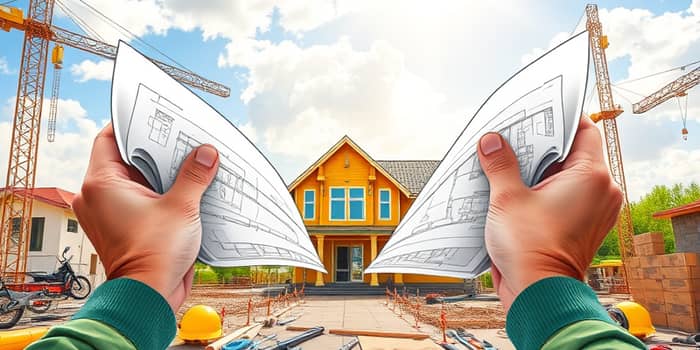
Building your dream home begins long before the first shovel breaks ground. Understanding the path to loan approval empowers you to navigate the process with confidence and clarity.
This guide unpacks the essential steps to secure a construction loan, blending inspiration with actionable advice to turn vision into reality.
- Assess Your Credit Score
- Evaluate Income and Employment
- Calculate Debt-to-Income (DTI) Ratio
- Prepare Down Payment and Reserves
- Gather Documentation and Plans
- Choose the Right Loan Type
- Select Builder and Secure Approvals
- Apply and Close Your Loan
Assess Your Credit Score
Your credit profile is the foundation of eligibility. Lenders view your history to gauge risk, so aim for a score that opens the best possible terms.
General construction loans often require a minimum score of 620–680, while conventional programs favor 680+. Government-backed options can be more lenient, but a higher score can save thousands in interest over time.
Evaluate Income and Employment
Stability is paramount. Lenders expect at least two years of consistent income, whether from a salaried job or verified self-employment.
Provide pay stubs, tax returns, and profit-and-loss statements to demonstrate proof of stable income that supports your construction budget.
Calculate Your Debt-to-Income Ratio
The debt-to-income (DTI) ratio compares monthly obligations to income. Keeping your ratio below industry thresholds signals financial health.
General guidelines include:
- Up to 45% debt-to-income ratio for most conventional loans.
- FHA loans often cap DTI at 43%.
- USDA programs limit DTI to 41%.
Exceptions may apply for energy-efficient projects or if you hold significant reserves.
Prepare Down Payment and Reserves
Construction loans carry higher risk, so lenders expect more skin in the game.
Typical requirements include:
At least 20% down payment for conventional construction loans.
Government-backed options vary: FHA may require as little as 3.5%, VA and USDA sometimes offer 0% down. Lenders also look for six months of payment reserves to cover unexpected expenses.
Gather Documentation and Plans
Detailed, organized paperwork streamlines approval. Assemble:
- Architectural plans and cost estimates.
- Permits and builder contracts.
- Draw schedules outlining disbursement timelines.
Working with a lender-approved builder ensures your documents meet underwriting standards and demonstrates detailed construction plans.
Choose the Right Loan Type
Understanding your options lets you align terms with goals. Common choices include:
One-time close loans combine construction and mortgage into a single application, reducing fees and closing steps.
Two-time close loans separate the construction phase from the permanent mortgage but may offer more tailored interest rates for each stage.
Government-backed variants—FHA, VA, USDA—offer accessible down payments and credit flexibility, while conventional loans often deliver the best rates for higher credit profiles.
Select Your Builder and Secure Approvals
Choosing a reputable builder is as crucial as picking the loan. Lenders vet contractors for:
Proof of licensure and insurance, positive references, and financial stability.
Ensure your builder provides a clear draw schedule and adheres to local permitting requirements. Lender approval of your team accelerates the loan process and instills confidence.
Apply and Close Your Loan
With documentation and approvals in hand, the formal application begins. Expect a 45–60 day timeline from submission to closing.
During underwriting, be mindful of:
No significant financial changes—avoid new debts or large purchases. Maintain consistent asset balances and verify information promptly.
Once approved, you’ll sign closing documents, fund reserves, and schedule the groundbreaking ceremony on your new home site.
Additional Tips and Best Practices
- Monitor your credit report regularly to dispute errors early.
- Keep an emergency reserve beyond construction costs for unplanned contingencies.
- Communicate transparently with your lender and builder to prevent delays.
- Consider energy-efficient upgrades for potential underwriting benefits.
Armed with this step-by-step eligibility roadmap, you can approach the construction loan process with clarity, purpose, and excitement. Each requirement you meet brings you closer to the home you’ve always envisioned—a tangible testament to careful planning, perseverance, and partnership.
Your dream home awaits. With diligence and the right guidance, you’ll soon stand on your future porch, knowing you built more than walls—you built hope and security for years to come.
References
- https://www.youtube.com/watch?v=ja99daY_rvA
- https://www.hfcuvt.com/post/building_your_dream_home.html
- https://www.fha.com/fha_loan_requirements
- https://ascend.bank/news/top-tips-for-qualifying-for-a-construction-loan-what-lenders-look-for/
- https://www.thefederalsavingsbank.com/Blog/construction-loans-process-timeline-and-borrower-requirements/
- https://gomortgage.com/credit-score-for-one-time-close-construction-loan/
- https://www.lendingtree.com/home/mortgage/minimum-mortgage-requirements/
- https://www.experian.com/blogs/ask-experian/how-to-get-fha-construction-loan/
- https://www.truliantfcu.org/borrow/construction-loans/what-are-the-requirements-for-a-construction-loan
- https://www.rocketmortgage.com/learn/usda-construction-loan
- https://www.amerisave.com/learn/your-complete-guide-to-construction-loans-in-building-your-dream-home-from-the-ground-up
- https://www.fha.com/fha_article?id=1352
- https://www.fhfa.gov/news/news-release/fhfa-announces-conforming-loan-limit-values-for-2026
- https://www.bankrate.com/mortgages/fha-construction-loans/
- https://www.rd.usda.gov/programs-services/single-family-housing-programs/single-family-housing-direct-home-loans